How to Preserve Funeral Flowers
After a funeral or memorial service, it is natural to want to keep a few flowers rather than let the entire arrangement fade away. A rose, lily or carnation will do as a tangible memento, as will a sprig of baby’s breath. There are several practical ways to learn how to preserve funeral flowers, and the right method depends on the flower, the desired keepsake, and how soon you can begin.
Preserving funeral flowers is possible in most cases, yet the outcome is contingent on the variety and how fresh and sound the petals are. It is better to get at it early; once wilting or browning sets in, or if there is any mold, the task becomes harder.
Can You Preserve Funeral Flowers?
You can. Air-drying, pressing, silica gel and professional preservation are all options. The question is whether the intent is to have a flat keepsake or to retain the flower in three dimensions. And there is no need to take on an entire arrangement. A more workable memorial piece can be had by culling the healthiest bloom or two.
How to Preserve Funeral Flowers?
1. Air-Drying
For roses, chrysanthemums, baby’s breath and the like, air-drying at home is about as straightforward as it gets. These are robust enough for it. Just clear away the foliage, put the stems in place and suspend the flowers in an upside down position where it is dry and dark with good ventilation. Do not let humidity or the sun get to them. While this approach is inexpensive and simple, be aware that color can alter and the flower may shrink or turn brittle. Thick blooms require a bit more time and a fair amount of airflow to see the process through.
2. Pressing Flowers
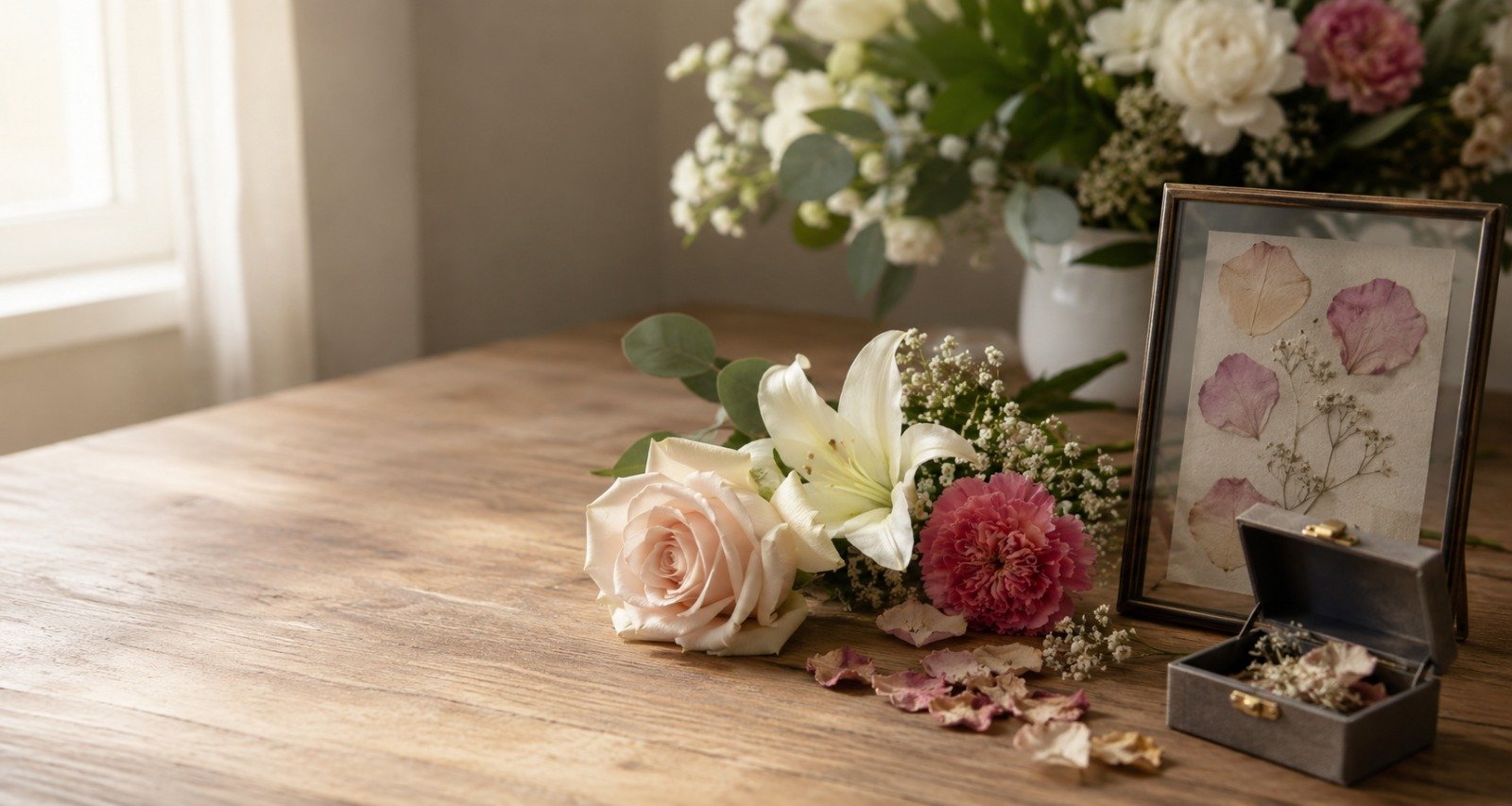
If you wish to keep individual pieces or petals and are not concerned with the shape of the bouquet, pressing is the way to go. Put the flowers, clean and dry, between paper that will absorb moisture and press with a heavy book or the like. Change out any damp paper and let them be until they are thoroughly dry. A pressed flower makes for a nice bookmark or memory card, or can be put in a frame for some memorial art. Flat and delicate flowers respond better to this than ones with a lot of moisture.
3. Silica Gel
Where the look and form of the flower is important, silica gel is an option. It encases the bloom in an airtight container and over time will draw the moisture from it while upholding its structure, something air-drying does not do. Make certain the gel is in contact with the petals. Drying times will differ so check on the flower from time to time. This is good for a flower that would not hold up well being hung to dry, but handle with care as the dried petals are prone to fragility.
4. Professional Preservation
In the case of a fine bouquet or one of special significance, or for a three-dimensional display, enlisting a professional can be worth it. Some prefer not to tinker with irreplaceable flowers when a finished memorial piece is called for. There are different approaches to professional preservation, so it is well to inquire as to the process and if the final product will be of the original color, shape and arrangement.
Preserving Funeral Flowers: When to Do It
Knowing how to preserve funeral flowers also means knowing when to begin, since fresh blooms are easier to preserve before significant wilting or browning occurs.. Once cut, fresh flowers are in a constant state of losing moisture and breaking down; too much time in water and they will wilt or turn brown and even grow mold.
Should you have to put off starting, see that the flowers are put somewhere cool out of any direct sun or undue heat. Put away any foliage that is the worse for wear and do not put damp flowers in an airtight container unless your method of preservation calls for it. One should not let flowers get to the point of being entirely wilted if they are to be preserved; the best work comes from the healthiest of blooms.
What Kind of Funeral Flowers Preserve Well?
1. It depends on the flower
Roses are frequently a good choice for air-drying or with silica gel. The robust petals of a carnation lend themselves to drying, as do many chrysanthemums. Lilies present more of a challenge given their moisture and the delicacy of the petals. Hydrangeas can be dried, though one may see some alteration in colour. Then there is baby’s breath which dries without trouble in its small clusters and makes a nice addition to other preserved flowers.
But do not expect uniform results from the same type of flower; growing conditions and freshness will play a part.
2. Making Use of Preserved Flowers
Instead of putting them away, preserved flowers make for unobtrusive memorial keepsakes. A framed pressed flower or a shadow box are but two possibilities, as are resin or memory boxes, small ornaments, bookmarks, decorative arrangements and other memorial art.
Resin will encase a flower in a solid keepsake, but only after it has been completely dry; any moisture left in will show in the end result.
3. The Life of a Preserved Flower
With due care in storage and handling, a properly done job will see the flowers in fine condition for years. They are not going to be permanent and will alter in appearance over time. Shield them from the elements – dust, humidity, moisture and the like – and from being handled too often. A frame or display case will go some way to ward off physical and environmental damage.
Which Method Is Best for How to Preserve Funeral Flowers?
| Method | Best For | Main Benefit |
| Air-drying | Whole flowers | Inexpensive and straightforward |
| Pressing Petals | Smaller flowers | Flat keepsakes |
| Silica gel | Where shape is paramount | For retention of form |
| Professional preservation | Arrangements of note | A polished look for the long term |
In the end, deciding how to preserve funeral flowers depends on what you want for a memorial and the condition of the blooms. For something irreplaceable or of particular import, you might find professional preservation to be the surest option.
An entire arrangement need not be saved to have meaning; a single petal or flower set aside can serve as a lasting memento.
FAQ
Q. Can you preserve funeral flowers?
Yes. Most funeral flowers can be preserved through air-drying, pressing, silica gel, or professional preservation.
Q. And how long will they last?
Years, provided they are kept from sunlight, humidity and the rest and not over-handled.